
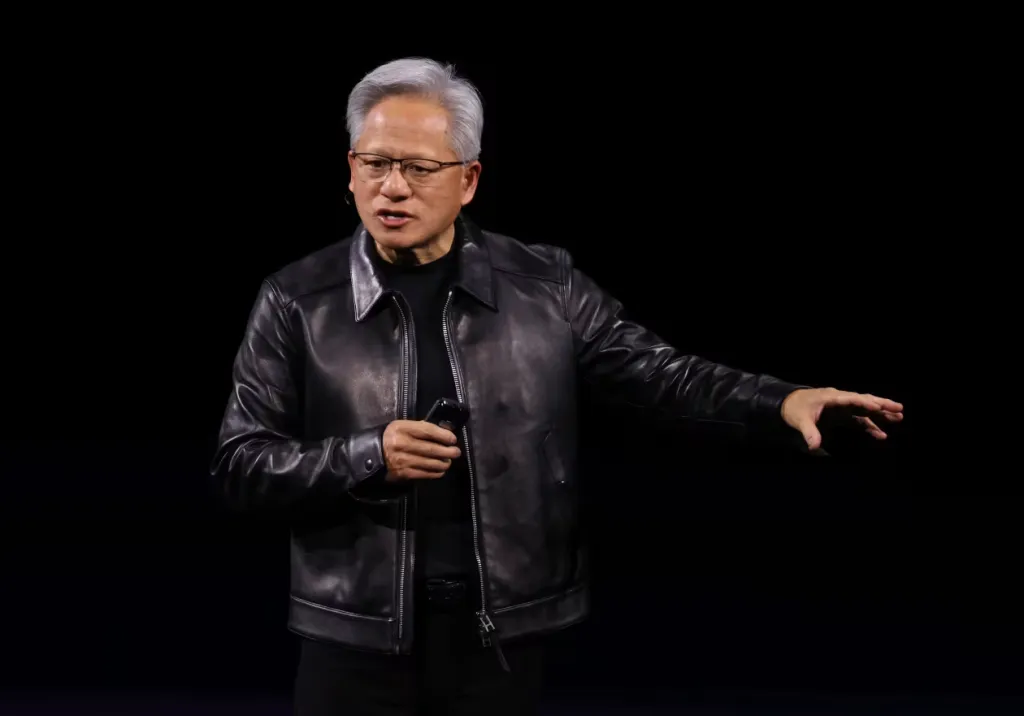
On 21 October, NVIDIA’s founder and CEO took the stage at Berlin’s Tempodrom with one clear message for the continent. Europe should not settle for consuming AI. It should be producing it.
The keynote capped a week-long tour of Paris, London, Stockholm and Dublin, during which NVIDIA said it has committed nearly $10 billion to Europe’s technology ecosystem and now works with more than 12,000 European partners. What followed was a tour of everything needed to make that ambition real: faster AI factories, safer agents, open models and AI that leaves the data centre for roads, hospitals and factory floors.
Here is what was announced and why it matters.
A new industrial revolution needs new infrastructure
Huang framed AI as the start of a new industrial revolution and explained it as a five-layer cake:
- Energy powers everything above it.
- Computing turns that energy into processing power.
- AI factories house that computing at scale.
- Models run inside those factories to generate tokens and intelligence.
- Applications put that intelligence to work in every industry.
His central point was about order. The internet needed networks before it could flourish and electricity needed a grid. In the same way, AI infrastructure has to exist before the models and applications can follow.
For Europe, that means owning more of the stack. Huang argued that countries and companies taking part in the AI economy should be producing AI as well as consuming it, and that Europe has already started.
AI factories in weeks, not months
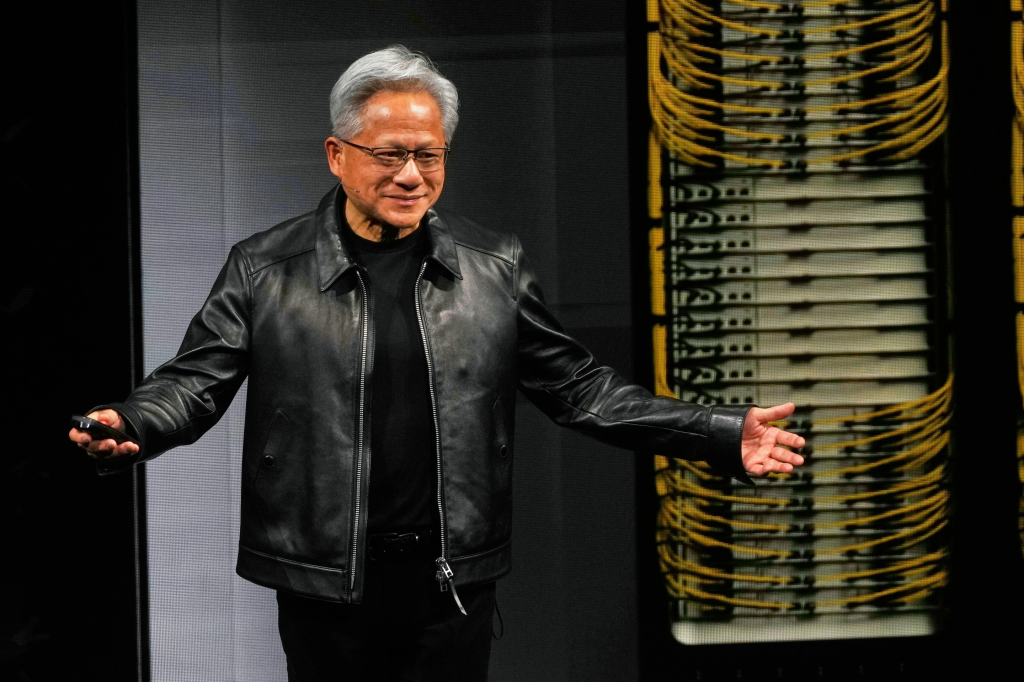
The biggest infrastructure announcement was NVIDIA DSX POD. It is a reference design for complete Vera Rubin AI factories, built by partners inside modular containers and fully tested before they leave the factory.
The headline figure is speed. Once a site has its power, cooling and networking ready, NVIDIA says deployment drops from around six months to as little as 14 days. As Huang put it in the launch announcement, “an AI factory creates value when it starts producing tokens”, not when construction finishes.
A long list of partners is lined up to deliver DSX POD worldwide from early 2027, including Dell Technologies, HPE, Lenovo, Schneider Electric, Vertiv, Bull and Foxconn.
Huang also confirmed that Vera Rubin is in full production, describing it as a platform built to run entire AI agents rather than just large language models. Alongside it, NVIDIA says its wider DSX AI factory platform can cut cooling water use by up to 100% and deliver the same AI output with up to 30% less power. For European operators facing tight energy and water constraints, those numbers will matter.
Agents are the new platform and security comes first
AI agents were the thread running through the whole keynote. Huang described them as systems that think, reason, iterate and use tools, and noted that the more useful they become, the more tokens they consume.
He broke an agent down into five parts:
- A model that does the reasoning
- A harness that orchestrates its work and memory
- A sandbox that isolates the harness
- Knowledge it can draw on
- Tools it can use to act
Because an autonomous agent can reach files, networks and systems, Huang was clear that security is the top priority. Agents should have minimal privileges, be monitored constantly and have permissions that change each time they run.
NVIDIA’s answer is the new OpenShell Reference Architecture for Safe AI Agents. It is built on OpenShell, NVIDIA’s open source runtime, which sits between an agent and the systems it can affect. It enforces policy and isolates the agent at kernel level. For any organisation nervous about letting agents loose on live systems, this was one of the most practical announcements of the day.
Open models turn your data into an advantage
Huang presented NVIDIA’s family of open models as the starting point for building AI that fits a specific organisation:
| Model family | Focus |
| Nemotron | Language and reasoning |
| Cosmos | World foundation models |
| GR00T | Humanoid robotics |
| Alpamayo | Autonomous vehicles |
| Ising | Quantum and classical computing |
| Earth-2 | Physics and climate AI |
NVIDIA publishes the models, the data and the scripts to reproduce them. A company can then post-train a model such as Nemotron on its own data for its own use case. Huang called the result “sovereign intelligence”: expertise that stays with the organisation that owns it.
To connect agents to that expertise, NVIDIA introduced the Agent Knowledge Foundation. It is a set of models and libraries that link agents to company documents and databases, including new Kumo models that make predictions from structured data. Huang’s view is that access to a company’s own knowledge is what turns an ordinary agent into a genuinely useful one.
The final piece is CUDA-X, NVIDIA’s collection of accelerated libraries used by more than 11 million developers. Huang described these simulators, solvers and data engines as the tools of the trade that agents will reach for.
A demonstration video brought it together. Agents helped Lila Sciences design a potential lymphoma therapy, prepared new products for production in Siemens’ Erlangen factory and refined a vehicle design at Dassault Systèmes.
AI leaves the data centre
Telecoms networks become AI networks
Huang predicted that every telecom operator will eventually provide AI computing, with base stations turning into distributed AI infrastructure. He pointed to around 100,000 sites and roughly 100 gigawatts of capacity across the industry.
After nearly eight years of work, NVIDIA has also made its first commercial phone call on T-Mobile’s network with Nokia. Huang summed it up with a smile: “Now CUDA makes phone calls.” Operators such as BT are already using Nemotron to build agents that check photos of field installations.
Healthcare gets physical AI
NVIDIA and Siemens Healthineers are developing AI-enabled adaptive radiotherapy. Agents coordinate treatment planning, a digital twin simulates how to target the tumour and live imaging adjusts the radiation as the patient moves. Huang described it as a physical AI problem, because the body and the tumour change during treatment.
Cars and robotaxis
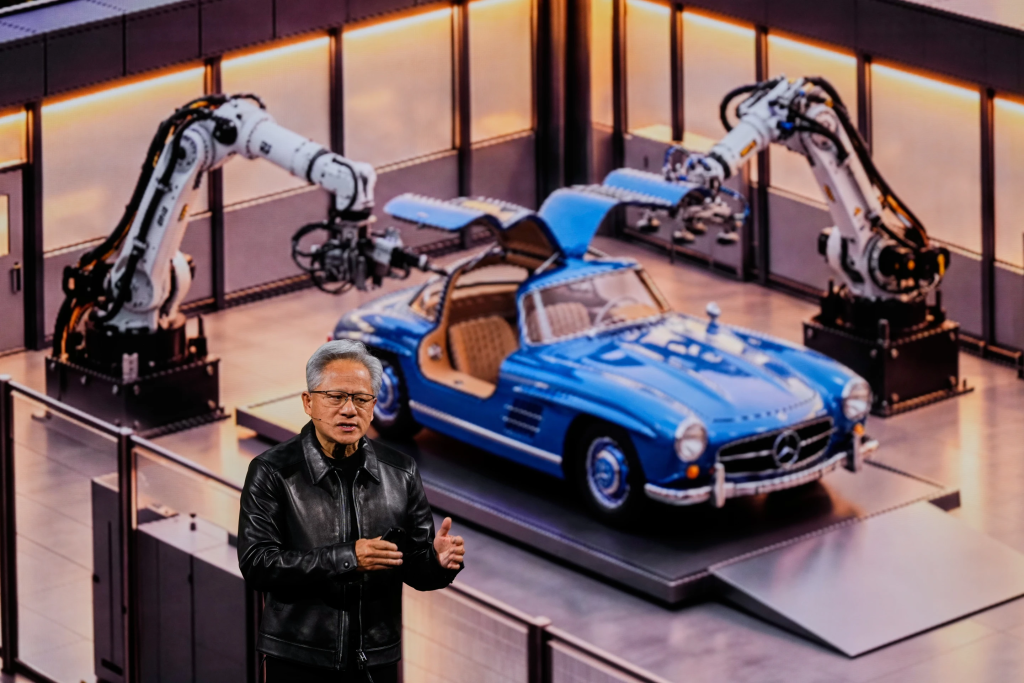
NVIDIA’s Hyperion self-driving platform is finding its way into more European fleets. Bolt with Lucid, Mercedes-Benz, Volkswagen Commercial Vehicles and Einride are showcasing level 3 and level 4 use cases, while Volvo Cars is adopting Hyperion and NVIDIA’s Alpamayo software. Huang added that next-generation vehicles from Volkswagen’s van business, JLR, Volvo and Mercedes-Benz will be Hyperion-compatible.
Robots, AI laptops and a flock of ducks
For robotics researchers, Huang announced Agile ONE SN, a reference humanoid built on Isaac GR00T. It has 31 degrees of freedom, is expected next year and is designed to cut research setup time from weeks to days. Agility Robotics, Figure, KUKA and NEURA Robotics are already building on the same platform.
He then turned to the desk. NVIDIA’s RTX Spark laptops, which launched last week, offer 1 petaflop of AI performance and 128GB of memory. Huang compared that with the DGX-1 he personally delivered to OpenAI in 2016, which had similar headline figures but needed two people to carry it upstairs.
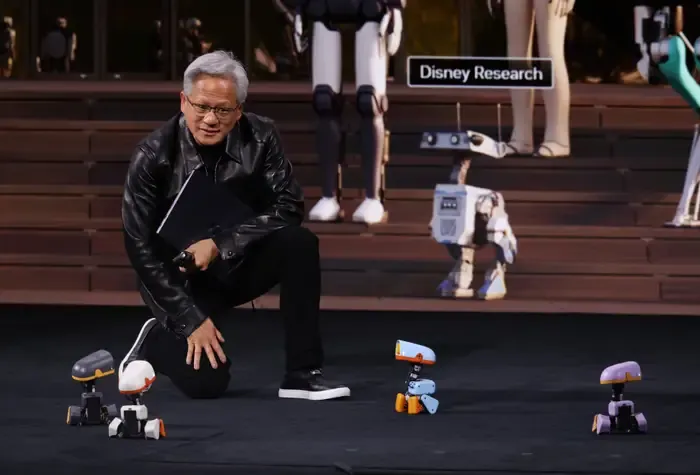
The most memorable moment came next. An agent had helped train Hugging Face’s small Microduck robots, moving between simulation, cloud training and an RTX Spark laptop. Four of them then joined Huang on stage, sitting, standing and even taking a nap on cue.
He closed by summing up three themes: Europe is building its AI economy, AI factories are evolving to run agents and physical AI is the next frontier. Then, fittingly for a European crowd, the keynote ended with a Eurovision-style musical recap.
What this means for your organisation
Strip away the stagecraft and GTC Berlin carried three practical messages for UK and European organisations.
- Infrastructure is the starting line. Agents, open models and physical AI all depend on having the right compute in place first. Faster deployment models such as DSX POD will change how quickly new capacity comes online.
- Your data is your edge. Open models plus post-training on your own data is now a realistic route to AI that is both capable and sovereign.
- Security has to be designed in. As agents gain access to real systems, isolation, policy control and monitoring move from nice to have to essential.
At Boston, we have worked alongside NVIDIA for many years, designing and building accelerated computing solutions for organisations across the UK and Europe. Whether you are planning your first AI deployment, scaling up for agentic workloads or weighing up what Vera Rubin means for your roadmap, our team can help you turn this week’s announcements into a plan that fits your workloads, your data and your budget.