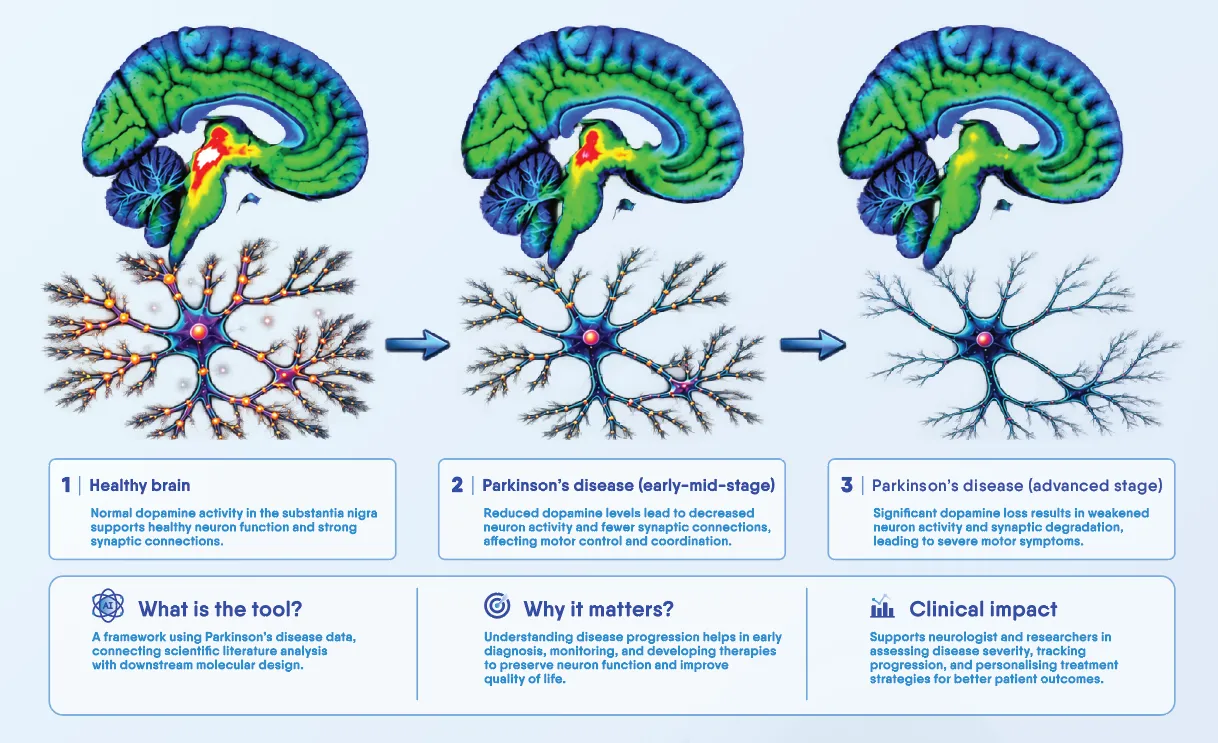
Consider how a project to find a new Parkinson’s disease therapy actually begins. Before any molecule is drawn, a researcher has to build a defensible picture of what to target. That means reading. Not a handful of papers, but a literature that now runs to tens of thousands of primary studies, reviews, conference abstracts and database entries, growing faster every year than any individual can follow. The genetics, the cell biology, the animal models and the failed clinical trials are all in there somewhere. The difficulty has never been a shortage of evidence. It is the time and effort of connecting it.
That connecting work is where months disappear. A scientist gathering evidence for a single candidate target can spend weeks tracing a pathway across studies that never cite one another, reconciling contradictory findings and checking whether a promising mechanism has already stalled in the clinic. Researchers at Cambridge, describing their own work on Parkinson’s, noted that simply identifying a lead candidate for further testing can take months or even years, and reported that a machine-learning approach sped that design process roughly ten-fold. The bottleneck is not intellectual. It is logistical. And it is expensive, because the most highly trained people in the building spend a large share of their time on retrieval rather than reasoning.
This is the problem the framework described here was built to probe. It is a proof of concept, not a product, and it is deliberately arranged so that the scientist remains the decision-maker at every consequential step. What it changes is the speed and completeness of the evidence-gathering that precedes those decisions.
Stage one: reading the literature at scale
The first component is an AI research assistant built on retrieval-augmented generation, or RAG. The term is worth unpacking, because it is what separates this from a general chatbot. A standard large language model answers from patterns it absorbed during training, which means it can produce fluent text that is subtly or completely wrong, an unacceptable property when the subject is disease mechanism. A RAG system works differently. It first retrieves the actual relevant sources, the papers, the review articles, the figures and tables, the biomedical database records, and only then reasons over that retrieved material. Every statement it produces can therefore be traced back to a real document rather than to the model’s memory. For scientific work, that traceability is the whole point.
Pointed at the Parkinson’s literature, the assistant reads across the corpus and extracts the entities that matter: genes, proteins, molecular pathways, mechanisms and biomarkers. More importantly, it connects them across studies. A genetic association reported in one cohort, a cell-biology mechanism described in another and a biomarker signal from a third can be drawn into a single coherent thread, the kind of synthesis that is entirely possible for a human to do but painfully slow to do exhaustively.
Crucially, the assistant weighs the evidence rather than simply listing it. For any candidate target it assembles the supporting lines of evidence across categories, cellular, genetic, animal, clinical, molecular and computational, so that a hypothesis backed only by a single in-vitro observation is not presented with the same confidence as one supported by human genetics and animal models alike. The output is a set of evidence-backed target hypotheses, each one a protein or mechanism with its supporting case laid out and linked to source.
The biology it surfaces is familiar to anyone in the field, which is a useful sanity check on the method. The standout druggable targets in Parkinson’s, alpha-synuclein, the protein that aggregates into the Lewy bodies that define the disease, leucine-rich repeat kinase 2 or LRRK2, whose overactive mutant forms drive pathology, and glucocerebrosidase, a lysosomal enzyme, are exactly the proteins a well-read specialist would nominate. The value is not that the system discovers something a human never could. It is that it assembles the complete, sourced evidential picture in hours rather than weeks, and does so without quietly missing the relevant paper published last month in a journal nobody on the team reads.
Then the process stops and hands back to the scientist. The researcher reviews the hypotheses, interrogates the underlying evidence and selects the target to pursue. Nothing proceeds on the model’s say-so. This is the design principle that matters most: the assistant compresses the search, the human makes the judgement.
Stage two: from a validated target to candidate molecules
Once a researcher has chosen and validated a target, the framework carries that decision into molecular design. The validated target is passed forward together with its identifying information, the UniProt accession that uniquely specifies the protein, for example P37840 in the case of alpha-synuclein, the protein sequence and the supporting evidence gathered in stage one.
From here the work becomes generative in the chemical sense. Rather than screening a fixed library of existing compounds and hoping something fits, de novo design generates novel molecules from first principles, proposing structures that do not yet exist in any catalogue. The framework generates two kinds of candidate: novel protein binders, designed to engage the target, and small molecules, the more traditional starting points for a drug. The distinction matters to a medicinal chemist, but the shared idea is that the candidates are designed against this target rather than retrieved from a shelf.
Because a molecule’s behaviour depends on its shape, the framework then models the candidates in three dimensions and simulates how each one interacts with the target protein, the geometry of the fit, the points of contact, the plausibility of binding. This computational modelling is not a verdict. It is a filter, a way of ranking and rationalising candidates so that scarce experimental effort is aimed at the most promising structures rather than spread thinly across all of them.
The output is a set of candidate molecules, each with its predicted three-dimensional interaction with the target, handed to the researcher for evaluation and, ultimately, for the experimental validation that no simulation can replace.
From research to molecules, with the scientist in the loop
The whole arc can be read as a single sentence: Parkinson’s literature, into an AI research assistant, producing a target protein, defined by its UniProt ID and its evidence, feeding molecular generation, and then three-dimensional modelling of the candidates. What travels along that chain is not authority but assembled evidence. The proof of concept demonstrates AI-assisted discovery, and it is explicit that target selection and validation remain researcher-led at every step.
It is worth being clear about what this does and does not claim. It does not design drugs. It does not identify a therapy, and nothing here is a clinical assertion about Parkinson’s disease. What it does is attack the specific, unglamorous cost that sits at the front of every discovery programme: the time a researcher spends trawling through literature and data to build the case for a target, and then the time spent turning that target into structures worth testing. Compressing that front end is not a small thing. It is often the difference between exploring three hypotheses in a funding cycle and exploring one.
There is a broader point about where machine assistance belongs in science. The framework is deliberately arranged so that the model does the work that scales badly for humans, exhaustive retrieval, cross-study synthesis, generating and geometrically screening large numbers of candidate structures, and the researcher does the work that should never be delegated, deciding what is worth pursuing and what the evidence really supports. Used that way, the technology does not replace scientific judgement. It gives the scientist more time to exercise it.
A note on how this was built
This framework was developed as a proof of concept on real Parkinson’s disease data, and the same architecture, evidence-grounded retrieval feeding target-directed molecular design, generalises to other diseases and other target classes. Boston builds and hosts the infrastructure such workflows run on, including the retrieval systems and the generative and structural models, on hardware sited so that proprietary research data stays within the institution’s own environment. Through Boston Labs, a research group can test a workflow like this against its own data before committing to it.